
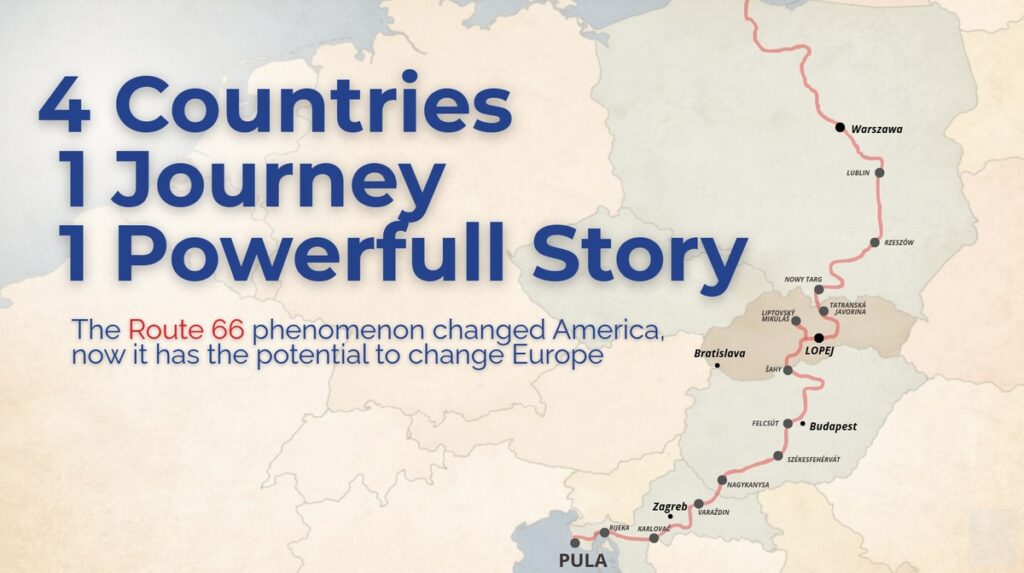
The European Route 66 project is the most significant development project in the Baltic-Adriatic corridor, aimed at developing tourism and supporting the economies of the participating countries. It builds on the successful knowledge and experience from the fifteen-year work of the Slovak project SK Route 66.
The basic objective of the European Route 66 project is the significant development of the regions and their economic sustainability and, last but not least, it contributes to increasing road safety. The inspiration for this symbolic designation „European Route 66“ was the legendary American Route 66 connecting the east coast of North America with the west. The European Route 66 connects the southern coast of Europe (Adria) with the northern (Baltic) coast. The European Route 66 route leads through important European regions with many tourist and natural attractions, significantly contributing to the development of tourism, trade and to learning about the cultural, sports and tourist traditions of the affected regions by increasing accessibility and visitor numbers, thereby also contributing significantly to the economic growth of the regions involved in the European Route 66 project.
The European Route 66 offers unique experiences and places that you won’t find anywhere else.
Discover the route that connects the cultures and traditions of Europe from south to north and create your own unique travel story. Share your experiences and adventures with our website visitors by sending us your story, complete with a few photos from your trip along the European Route 66. It doesn’t have to be about driving the entire route, just a part of it or participating in a cultural, sports or tourist event. Send your contributions to us by email at:. routesk66@gmail.com
Poland
Poland is a country in Central Europe, bordering Germany, the Czech Republic, Slovakia, Ukraine, Belarus, Lithuania, and Russia (Kaliningrad Oblast) to the north and the Baltic Sea to the south. The capital is Warsaw. Poland has a rich history that includes periods of kingdoms, divisions between neighboring powers, and reconstruction after World War II. Poland is known for its culture, traditional cuisine, historical monuments, and the natural beauty of the Tatra Mountains, the Masurian Lake District, and the Baltic Sea.
European Route 66 through Poland
The European Route 66 route starts in Gdansk at the mouth of the Vistula dead end (Port Canal) into the Baltic Sea. You set off on the route from a nearby parking lot along road No. 91 to the intersection with road No. 89, which is formed by a large roundabout Rondo Mazowieckiego, from which the route leads through a tunnel under the Vistula dead end to the intersection with road S7 south of Gdansk. The route then follows road S7/E77 to the city of Olsztynek, before which it turns onto road S51 and continues towards Olsztyn, which bypasses the southern bypass and after Olsztyn continues along road 16/S16 to the Masurian Lake District to Mikolajki and past the largest Masurian Lake, Śniardwy, to Orzysz. After the city of Elk, the route continues south towards Warsaw on road S61/E67. Near Ostrów Mazowiecka, you need to turn onto the S8/E67 road to Warsaw to its eastern part, Zielonka, where the route turns onto road 631 to the Marysin Wawerski section, where after the Orlen gas station on the right, you need to turn left and join road 628 – Bronislawa Czecha Street, which smoothly passes into Trakt Brzeskiho. In the Stara Milosna section, where at a large roundabout, route ER 66 continues along road S17 towards Lublin. Lublin is bypassed by road S19 along its western bypass. Along road S19, the route continues to Rzeszów, where on its eastern edge, road S19 passes directly, without turning onto road 97, then 94, and in the Dabrowskiego district, it turns left onto road 19/E371, which it continues to Krosno. From Krosno it continues along road number 28 via Jaslo to Novi Sad and further to . From Novi Sad it leads along road number 28 to Rabka-Zdroj, which leads along its western edge. After Rabka it is necessary to turn onto road number 47 towards Chabówka, Nowy Targ. From Nowy Targ it continues along road number 49 to the border with Slovakia with the border crossing Jurgów-Podspády.
The length of the European Route 66 route in Poland reaches approximately 1160 km.

Slovakia
Slovakia is a country in Central Europe, known for its rich history, beautiful nature and rich cultural heritage. The capital is Bratislava, which lies on the banks of the Danube River near the borders with Austria and Hungary. Slovakia is known for its picturesque mountains, especially the smallest high mountains in the world – the High Tatras, but also the Low Tatras, which are a popular destination for tourists and winter sports enthusiasts and nature lovers. The country has a diverse culture, which is reflected in traditional folk costumes, music and dances. Slovakia offers visitors a number of historical monuments, chateaux, castles and thermal baths.
European Route 66 through Slovakia
The European Route 66 is identical to the Slovak Route 66, which runs through Slovakia from the border crossing with Poland in Podspády to Šiai near the border with Hungary. The road is marked 66 along the entire route, so you won’t get lost on this route. Approximately in the middle of the route in Lopeja, the Podbrezová district, the European Route 66 Headquarters is located. The extended branch of the R66 also leads to Liptovský Mikuláš through the Low Tatras mountains and the Čertovica saddle. Along its route, you will find many tourist and culturally interesting places such as Banská Bystrica – the center of the Slovak National Uprising, but also Zvolen and Krupina, which is among the oldest cities in Slovakia. Above Zvolená, the ruins of the Pustý hrad castle complex, which is the largest medieval castle in Central Europe, rise. In the town of Krupina, the preserved Vartovka watchtower from the time of the Turkish raids, still stands.
The length of the European Route 66 in Slovakia is approximately 270 km and you can drive it in approximately 5 hours if you follow the traffic rules. With the extended branch to Liptovský Mikuláš, the length of the European Route66 route is approximately 326 km.

Hungary
Hungary is a country in Central Europe, known for its rich history, culture and unique Hungarian language. The capital is Budapest, with a population of two million, which is a major cultural and economic center. Hungary is characterized by its thermal springs, a large lake – Balaton and traditional cuisine, the most famous of which is Hungarian goulash or paprikash and fish soup Halászlé. The country has a variety of natural scenery, from flat lowlands to gentle hills and mountains.
European Route 66 through Hungary
European Route 66 continues from the border crossing with Slovakia Šahy – Parassapuszta to the town of Leténye on the border with Croatia. The route passes through the territory of Hont on the road 2/E77 to Vác and Budapest, where in Dunakezs it crosses the Megyeri Bridge to the right side of the Danube and continues on road no. 11 to Szentendre and from there on road 1116 to Pilisszentlászló to Lepec, where it joins road no. 11 again at the Danube. It leads along the Danube to the historic Esztergom, where it diverts to Tat, from Tat it leads on road no. 103 towards Banja and on road no. 1119 to the famous town of Tatabánya. From Tatabánya it continues to Szekésfehérvár, which it bypasses on the bypass road no. 7/E66 and on road 8/E66 to Veszprém, from which the route of European Route 66 leads on road no. 73 to Lake Balaton. From Balatonfüred it leads on road no. 71 along its coast to Keszthely. After Balatonszentgyörgy, the route connects to road no. 7 and continues through Nagykanizsa to Letenye and to the border with Croatia.
The length of European Route 66 in Hungary is approximately 430 km and you can complete it in 7 hours, following traffic rules and the current traffic situation on the roads.

Croatia
Croatia is a beautiful country located in southeastern Europe on the Adriatic coast. It is known for its rich history, picturesque beaches, crystal clear sea and charming islands. The capital city of Zagreb offers a combination of historical architecture and modern life. Croatia is a popular summer destination for lovers of the sea, nature, culture and gastronomy, where you can taste traditional dishes and wines. In addition to tourist attractions, there are also national parks with lush greenery and unique fauna.
European Route 66 through Croatia
The journey along the European Route 66 in Croatia begins at the border crossing with Hungary Letenye-Hodošan on the D3 road through Čakovec, Varaždin, Novi Marof, Sveti Ivan Zelina to Popovec before Zagreb. To Zagreb, continue along the Varaždinska road (road no. 1013). Through Zagreb, the route of the European Route 66 continues along roads no. 1026 and 1027 to the interchange with Slavonska avenue (road no. 1035), where you turn right, then continue to the nearest interchange, before which you turn right onto Vjekoslava Heinzela street and at the nearest traffic lights turn left onto Ulica grada Vukovara. At the second traffic lights, turn left onto Avenjja Marina Držica. After crossing the Sava River, you need to turn right into the turning lane onto road 1040 (Avenija Dubrovnik Street) road no. 1040. From this road, at the 8th traffic light, turn left towards Remetinec, then after the roundabout, turn right towards Blato (Karlovačka cesta) and then along the D1 road to Jestrabsko to Karlovac. When passing through Zagreb, I recommend using a navigation system to which you import the attached route in GPX format.
European route 66 continues in Karlovac, turning right onto the D3 past Vrbovsko through Delnice to Rijeka, where under the railway overpass by the Riječina River it turns right over the river and immediately turns left past the INA – Školjič gas station. From this gas station it continues under the D8 designation along the port and the coast along the entire length of Rijeka to the roundabout after Rijeka, from which at the second exit it continues on road number D66 through Opatija, along the coast and Labin to Pula. European route 66 ends at the Shell gas station on the Adriatic coast.
The length of European Route 66 in Croatia is approximately 405 km and you can drive it in 7 hours if you follow the traffic rules and the current traffic situation on the roads.
